Archive

Rules 3.1 – The New Miracles

It was deep enough into spring that night on that broad mountain that the frogs came out of their hiding places to sing.  The katydids filled the night with their buzzing and whirring, and the cicadas, though fewest in number, where the loudest of all.  It would drive a person mad if it weren’t so beautiful.

The blue darkness of night covered the camp, and the stars were big and bright.  They were brighter than they’d been in over a century, now that there was no magic below, and no lights aside from fireflies and foxfire, and a few torches and primitive oil lamps like the ones in the town hall.

Hard work makes the past matter less, Kyrie thought as she lay down on her cot for her fourth night.  She didn’t care that the world had ended.  She had worked hard.  She had eaten enough.  Now she was lying in bed, more ready for sleep than she’d ever been before.  She knew it was poison, what she was thinking.  She knew the past had to matter.  She knew that someone had to find the truth behind the Cataclysm, had to see that justice was done, had to restore order in the world.  But she also knew she didn’t care, didn’t have the strength to worry.  She was powerless to change the world, and that was fine.  It felt good, laying her head on the pillow and closing her eyes.  Life was good, life was bad, and she was going to bed.

She started to dream even before she was unconscious:  a man walked up to the window with a bird in his hands.  He opened his fingers, but the bird wouldn’t fly.  He brought his hands up to encourage it, but it was dead.  So he threw it to her right where she lay, and it struck her in the face.

Kyrie jerked her head back, and she was so close to wakefulness that she opened her eyes at once and saw a crumpled piece of paper next to her pillow.  Since she shared her bunkhouse with seven other women, she uncrumpled it carefully so as not to wake any of them or catch their attention.  Unfortunately, it was too dark to make out any of it, so she crept out of her bunk and made her way out the door so she could try to read it by moonlight.  The front door squeaked, but no one would be made suspicious at that—women came and went throughout the night to go to the outhouse.  What they never did was uncrumple pieces of paper.

Once outside, she walked a few paces from the door and held the note up to the light of the waning moon.

“Come outside,” it said.

She wadded it back up again and started looking around.  She heard fingers snapping and followed the sound around the corner of the bunkhouse, to a deep black shadow, but no one was there.  She walked around the back of the bunkhouse and still saw no one.  But the shadow of a treetop just brushed the back wall, and its trunk paved a road of shade leading past the edge of the women’s village.

So, without any other hint, she headed toward the tree.  She got there and, finding no one, looked up into the boughs, but couldn’t see much of anything up there.

A whisper came from the fence, just loud enough to cut across a small cow pasture: “Over here.”

Kyrie followed and, once at the fence, again saw no one, but, finding a dip in the ground where she couldn’t be seen from far off, she squatted with her back to a fence post, listening closely for another sign.

“It’s good to see you,” said a voice—softly spoken, but not a whisper.

Staying low, she turned on her feet, and on the other side of the chain link was Jaysynn, squatting so they were eye-to-eye.  Before saying a word her eyes turned and ran across the top and bottom of the fence, looking for a tunnel below or a gap in the razor wire above.  “How did you get out?” she said.

“Don’t worry about it,” Jaysynn said.  “It’s something I do well.  You wouldn’t be able to get out the same way.”

“Well, find another way,” she said.  “Or get some tools and cut a hole in the fence.  Right here.  I’ll know right where to find it, and no one will be able to see you.”

Jaysynn shook his head and gave a hint of a sigh.  “No, look:  I didn’t come here to bust you out.  I just wanted to talk a little, see how you’re doing.”

With those words, Kyrie’s shoulders deflated—not because her hopes of escape had been crushed, but because she remembered that just minutes ago she didn’t want to escape.  She was as happy as she cared to be, and she was going to let somebody else worry about the world’s problems.  Now she realized that those problems were Jaysynn’s burden, and that he didn’t care either.

Rules 2.4 – The New Rules

“Very well then,” said Tarc.  “My men will show you to your quarters.”

“Wait,” said the nervous man from the bus. “Some of us weren’t planning on staying here.”

“I don’t care about that,” said Tarc.

“The bus driver…”

“I also don’t care what the bus driver said.  He lied.”

“What do you mean he lied?”

“I paid him to lie,” said Tarc.  “I paid him to get you all here without incident.”

“So we’re stuck here?” said the man.  His face had turned a passionate red.  “Look—we came here because Remirion is supposed to be the land of the free.  And you’re saying we can’t even leave the camp without your say-so?  This is an atrocity of human rights.”

Tarc was unmoved.  “My hands are clean on that matter, actually:  you can thank the Governor for that rule.  He’s declared a state of war, and no foreigner is allowed into the city.  If you were to leave, sir, there would be nowhere to go.  This is the only place on Lamora where there is a home for you.”

“That’s a lie, too,” said the man, pointing a finger.  “Just like you told the driver to lie, you’re lying to us.  There’s no state of war.  Who is Remirion at war with?”

“With nobody in particular,” said Tarc.  “But the governor suspects that the security of Remirion—or Falcon Point as we call it here—is in jeopardy, and, frankly, only an idiot would disagree with him.  I’m sure we’ve got a few idiots in our employ, but they will find themselves utterly powerless to change the Governor’s policies or mine.  As I said, the times will get better.  Stability will return eventually, and this restriction will be lifted as soon as possible.”

The man focused a hot stare at Tarc.  “This is inhuman.  Foreigners aren’t allowed in your city.  So you make them into slaves.”

Tarc turned to the guard who had announced his coming.  He spoke loud enough for everyone in the room to hear:  “Give him the idiot treatment.”

The man with the red face went on, “I thought Remirion—Falcon Point—stood for justice and equality!  I thought this was the great bastion of freedom in the modern world.”

A rod struck him in the forehead.  The bright red of his face gushed out into a puddle on the floor and his body collapsed, knocked unconscious by the blow.

The other passengers grew defensive.  Some grumbled to one another, others shouted at Tarc and the guards.  Kyrie’s father called him a monster.  One of her brothers told him to burn in Barathrum.  Jaysynn was quiet, desiring not to be recognized.

But Tarc’s voice was powerful enough to squelch them all, and his stance was as bold as Governor Vac’s had been when he faced the mob.  They were similar men with a similar build, but Tarc was bigger, and not so old.  “You’re in a room full of armed guards who will cause you all the pain I want them to,” he said.  “And it’s lucky for you that I’m a more generous man than you think I am, and that I don’t want them to raise a finger.”  He paused to let them consider the possibility of his violence, and the possibility of his mercy.  “You’ll be surprised at how quickly you learn the new rules,” he said.  “Now, I’m sure you’re eager to see your new quarters.”

Rules 2.3 – The New Rules

He and Kyrie, along with her family and the other passengers, entered into the cool dark of the building.  Little sunlight crept in through the windows, so most of the light in the crowded room came from oil lamps crudely cut from old tin coffee cans.

No one was in the room to greet them other than a few more guards who lined the walls.  The passengers began to murmur among themselves, and to take note of the armed men in black who seemed to be their new masters.  Their shirts were black as pitch, and in the poorly lit room they stood like shadows armed with sword and club.

Though they gave the impression of a disciplined military, their shirts didn’t match.  They had all been dyed the same deep black, but they were all a different cut.  Whatever shirts these men happened to own became their uniforms when they fell under the reign of the head of the camp.

The tension grew for less than a minute when the guard with the hat tapped one of his men and pointed toward the front of the room.  The other guard saluted him and  moved before the crowd.  His voice was shrill, and soared above the grumble of the passengers:  “Quiet.  Tarc has a few words to say.  There are to be no interruptions when he speaks.”

Those words ushered in silence, and a big man came in from another room.  Authority was in his bearing and in his blood, and in fact this man Tarc was Governor Vac’s brother.  He walked like a wall cloud:  big and slow, but gripping the attention of everyone within twenty miles, because it was clear that somewhere in his being he carried the strength of a whirlwind.

“Welcome,” he said, facing the small crowd.  His tone was as friendly as dirt.  “You’re all here today because this world is dying, and this farm is not.  Because outside those walls people are killing each other for bread, but in here, there is food for anyone who works.  You’re here for your own survival.  I’m here for my survival.  In that way we’re very much alike.  The difference is this:  My job is to make the rules that help keep us all alive, and your job is to follow those rules.

“Today I want to give you a brief overview of those rules.  If you don’t learn them today, that’s fine.  I have no problem with slow learners.  But understand that there will be consequences.  Loss of eating privileges.  Corporal punishment.  I don’t prescribe these things because I don’t like you—I do it because I have found that these are the best ways to help slow learners.  If a dog doesn’t sit when you say ‘sit,’ you strike it—and this is an act of love.

“You have seen a small portion of this camp.  The men’s village is just outside; the women’s village is on the other side of the camp.  Any man who thinks about sneaking over to the women’s camp, consider the fruit of your secret visit:  that woman will have to toss her baby over the wall.  Because in this camp no one—absolutely no one—who does not work will eat.  It doesn’t matter if they are little and cute.  It doesn’t matter if it’s your baby.

“If any man is injured, he must work, because—by the laws of survival—we cannot afford to feed him.  Therefore, your safety is a great priority for you as well as for me.  Anyone who puts himself at risk of injury will be punished.  I see a cripple in the crowd here.  It used to be that there were resources in this world to take care of people like you.  Those resources are gone.  So now you will have to earn your survival day by day like the rest of us.  The same goes for the children.

“No one is to leave the camp and no one is to go into the city without my express permission.  No one is to eat more than his fair share, and no one working with food or crops is allowed to eat anything.  If any man should steal, his rations will be garnished until the debt is paid twice over.  If he starves, we will call it justice.

“Now, as I’m sure you can tell, you’re still alive.  Your hearts are still pumping blood through your veins.  And that means that the world isn’t over.  And life isn’t over.  And the times will get better.  But for now things are going to be difficult.  You’re going to have to work—and work hard.  And you’re going to have to follow rules that you won’t like.  But the times will get better.  If we persevere.  If we work together.  Is that understood?”

Whether awed by Tarc’s presence or terrified by his guards, all were silent.

Rules 2.2 – The New Rules

Kyrie’s father returned to his children, three daughters and two sons, of whom Kyrie was the oldest.  Their mother was not present.  She had been laid to rest a year earlier.  Kyrie had hoped to raise money to buy the medicine she needed to live, but medicine has little power against the order of life and death.  The job that she had gotten at the bakery was a great blessing to her and her family, to be sure, but it could not save everyone.

Aside from Kyrie’s family and Jaysynn, and the red-faced man who sat near the front of the bus, about a dozen others were on board, most of them young men.

They all were silent now.  They were like colorless clay sculptures of men—flesh and blood, but without passion or investment or virtue until such a time when their fates would become apparent.  Kyrie’s family looked at one another, but the young men on the bus, the men who had no families, stared out the windows, at the rocks and trees.  And every once in a while the trees would part, and the view from the mountain trail would open up to miles and miles of open country.  A sea of trees.  And beyond the treetops, grassy plains.  And beyond the grass, far from the Well at the center of Falcon Point, was desert.

Life came from the wells.  It always had.  And where there were no wells, there was no life, no vegetation.  Now the wells were destroyed.  Jaysynn and Kyrie and the others took that lonely mountain trail to a farming camp.  They had work, which was a blessing, it’s true.  But how long the crops would spring up from the ground in a land without magic, no one knew.

People were starving now for lack of work.  But perhaps a time was coming soon when all of Lamora would starve.  The plants would wither, and soon nothing would be left but the desert dust.

So, without destinies, the passengers on the bus were silent, and they seldom twitched or moved.

At last the bus arrived at the gates of Tarc’s camp.  Through the chain link fence were rows of shoddy new buildings, all whitewashed, all identical in shape and size.  The ground around them was beaten raw by the footfalls of the workers—so the bunkhouse village already looked like the desert had newly reached it.  This was visible to the passengers only through the towering fence, taller than any of the buildings in the whole camp and topped with razor wire.

The gate was a different matter.  On either side of it were concrete towers, and two watchmen were posted in each.  Whether their job was to keep people in or out was not clear, but it was clear that all four of them were needed in order to open the gate.  It was a giant bi-fold door, built of metal scrapped from automobile chassis and then coated in black oxide paint.

The men climbed down from their towers and muscled the gate open, and when the bus was inside, they pulled it shut again and stood with their backs to it, facing the bus.  They wore short swords on their hips.

A dozen other men in charcoal black shirts and pants surrounded the bus, mostly unarmed, but a few carried batons. One of the twelve wore a hat.  It was short-brimmed and dressy, but three bars were sown onto it like it was some kind of military rank.  Around his waist hung a cavalry sword.  He and the others formed a semicircle around the bus door and waited for the passengers to come out.

“This is the Tarc Refugee Camp,” said the driver.  “Everyone off.”

With a little hesitation, but otherwise without incident, the passengers filled the aisles and made their way out of the bus and onto the yard.  Their feet kicked up dry dust when they met the ground.

One of the men pointed his baton toward a building across the yard, opposite the bunkhouse village.  “Head in that building across the way and we’ll get everybody sorted out,” he said.

Some of the young men were already shuffling that way when Kyrie and her family and Jaysynn got off the bus.  There was a little crab grass growing around the building.  Its boards were in good shape—they were all new—but it had been nailed together in a hurry.  The lines didn’t seem quite straight.  The corners didn’t match up quite right.

“Just across the way,” the man said.  “That’s town hall right there.”  He smiled at the man with the hat, amused at his little joke.  The other man didn’t smile back, but stared at Jaysynn—the stare that solves mysteries: every muscle on the man’s face was tense.

Jaysynn hid his lips behind Kyrie and whispered, “One of these guys knows who I am.  He’s trying to remember.”

“Let’s just go with the crowd,” she said.

Jaysynn went on, “If word gets around that I’m here, there could be trouble.”

The young emperor walked in the middle of the crowd, trying to casually hide his face among the others, trying to stoop his shoulders and change his gait and make his expression blank, trying to look not like himself.

“Nobody recognized you,” Kyrie said when they were near the doorway of the main building.

“They will,” said Jaysynn.

Rules 2.1 – The New Rules

An old bus squealed and hissed as it came to a halt.  Ten days ago it was an antique, and the man who owned it and maintained it was an eccentric:  his mind was in the past and not the present, and he loved experiments more than practical accomplishments.  Now that the cataclysm had wiped out the magic engines and weapons and computers, this steam-powered bus was suddenly one of the most advanced pieces of technology on the planet, and its owner was reaping a fortune driving people out of Thyrion and into Falcon Point.  His fares were modest, but he was paid well on delivery:  a third party was eager for bodies.

“Alright,” said the driver, standing to his feet and pulling a list of names out of his pocket.  “Some of you are supposed to get off here.”  He read the list of names.  Jaysynn and Kyrie and her family were not on it.  “Have your ID ready as you get off.  If you don’t, the guards outside will turn you back around.”

Jaysynn had lain in the aisle for most of the trip, but now he was in a seat next to Kyrie, watching the people on the list getting off the bus.  “I don’t like this,” he said.

“Maybe they’re criminals,” Kyrie said.

Her father sat in the seat in front of them.  He was an ex-military man, and still wore his hair according to regulations.  He turned around to face the others and added, “Maybe we’re the criminals.”  He nodded once like he’d just delivered the ultimate commentary, but the others were not yet convinced.

“There’s a lot of people still on the bus that don’t have any connection to Jaysynn,” Kyrie said.  “I don’t think we’ve been caught.”

“Maybe not,” Jaysynn said. “But I still don’t like it.”

Kyrie’s father glanced around the bus.  “Aside from our family,” he said, “there’s only one woman staying on the bus.  That’s not a good sign.  And she looks kinda criminal.”

Kyrie, each of her siblings, and Jaysynn all turned to catch a glance of the woman; and the young ones, in particular, were not subtle about it.  This woman was their test:  if she looked like a captured convict, they all were convicts.

She looked poor, unwashed for at least a week.  But not many in Thyrion had the luxury of bathing in that past week:  all were poor.  The real clue was her jaw:  it was muscular, strong as stone from over thirty years of gritting her teeth.

As this strange thing was happening—as half the passengers were allowed to get off and the others forbidden from leaving—this woman sat silently, expressionless, except for a tight forehead and a slight frown that probably never left her face.

She took no notice—or pretended not to—when three girls and two boys and two grown men turned around to catch a glimpse of her.

As each of them tried in his own mind to decide if she was a lawbreaker, an argument started just outside the bus door.  A frantic man with a high-pitched voice had been talking for some time, but suddenly his voice raised to a shout.  “I forgot my ID.  Let me go get my family and they can tell you who I am.”

“I’m sorry sir,” said one of the guards.  “You’ll have to return to the bus.  Your family will know where to find you.”  He motioned toward the bus.

“No,” said the man. “This isn’t fair.”  Two of the guards grabbed his arms and helped him into the bus.  He kicked and flailed.  “I don’t want to stay on the bus.  I want to go with them.”

“You’re going to go to a place that has food and water and shelter,” said the guard.  “And that’s better than where these people are going.”

“Why?  Where are they going?”

“They’re free,” said the one guard.

“Free to starve,” said the other.

The man grew suddenly passive as the guards pushed him into an empty seat.  His face was red and beads of sweat popped out of his skin.  But he was breathing slowly and deeply.  A strange, despairing calm had washed over him.

“You’ll live,” said the guard.  “Be thankful.”

They exited the vehicle, chests puffed out in silent celebration of their authority, and the bus squeaked and squealed as it built its momentum and rolled down the road.

Kyrie tapped Jaysynn on the shoulder.  “Why don’t you ask the driver where we’re going?”  He shifted his weight in his seat.  The bus trembled as it rolled over the rough mountain road.

“I’ll talk to him,” her father said.  He stood and walked up the aisle.  He moved slowly and only with the help of a crutch, because the muscles on one of his legs were worthless—the reward for his service to Thyrion.  When he reached the front of the bus he leaned over the driver and said, “What’s this about?”

The driver was unintimidated, almost bored, like this kind of exchange was as routine as glancing over his shoulder when changing lanes.  “I’m about the luckiest man in the world, I figure,” he said, “‘cause businesses are all going in the tank.  The mines are shut down, and the factories.   Everybody’s hungry.  Nothing to do to earn a living any more.  But me, I got a job.  And you’re all gonna have jobs, too.  This bus is going to Tarc’s farm—it’s a refugee camp.  And old Tarc, he’s gonna take care of you.  It’ll be some hard work, but hard work—any work—is the best blessing in the world right now.”

“Why didn’t you tell us this was part of the deal before we got on the bus?”

“Sorry if you didn’t know, mister.  If you don’t want to work, just let old Tarc know.  He pays me to deliver, so I deliver.  And then if you decide you don’t want a job, well, that’s fine with me—I still get paid.”

“Well, fine,” said Kyrie’s father.  “I just don’t like the dishonesty.  That’s no way to treat people.”

“People don’t always treat each other good,” said the driver, his eyes on the road.

Rules 1.2 – The Brink of Revolution

Without another word, Vac rose to his feet.  It was a slow process:  he was a man of bulk—not tall by any measure, but stocky, densely built.  His joints were getting a little old.  So sometimes the limitations of his body robbed him of his haste.

And in times of crisis he deliberately moved slowly.  It was his private little method of mastering the world.  He who is afraid runs around like a headless chicken.  And he who fears nothing stands up slowly, and walks slowly across the room, and slowly down the hall.  He moves step-by-step onto the balcony, into the cold wind.  But he does not lay his hand leisurely on the balustrade—he does so with absolute deliberation.  And he does not rest his hand upon the rail—he grips it.

In that way Vac moved to face the crowd from above.  The mob gushed through the streets like a flooded river, but spotted Governor Vac on the balcony before they had reached the heavy front doors to the Old Fort.  When he made his appearance before them, they drew to a halt.  The cobblestone streets of the old district were full of gaunt-faced men brandishing knives and broomsticks.  And, in recent years, swords had become popular decorations, commemorating the bold and fiercely independent heritage of Falcon Point, so a good number of the rioters had blades tailor-made for the killing of men.

These they lifted high above their heads, shouting threats and curses at the governor, which echoed through the corridors of the old district, with its streets of stone and its buildings of brick and plaster.  The clamor of the crowd was threat upon threat, each cry ringing through the street blurring together with all the other cries so that nothing that anyone said was intelligible to the man they were yelling at.

Vac answered with a steadfast glare, and he gripped the railing on the balcony.  The Old Fort was a stone sentinel.  The sky at his back was duller than slate.

From the moment he first showed his face, the shouts crescendoed for several minutes, but in time they began to dwindle slightly.  They would escalate again soon enough, for the volume of an impassioned crowd cycles up and down as perfectly as a sine wave.

When the low point in that cycle came, Vac’s voice boomed across the crowd:  “What do I have to say for myself, you ask?”

Whether or not anyone had asked that, he had no idea.  But he asked it with such dominance that they all believed that they had collectively asked precisely that question.  So their shouts declined further still.  Some of them repeated his question back at him.  But the cycle was broken.  Their cries did not redouble, but they dried out, wilted, and at last faded into silence.  Two thousand angry young men, at least, were hushed in anticipation of Vac’s answer to their burning question.

He milked the silence.  He knew how long it would last and how long it would not last.  He could read it in the tension of the air, and in the eyes of each man in the crowd—and he met many of those eyes directly.

Just before the first murmurings resumed, he spoke: “I can understand why you’re all here.  You’ve lost a lot lately and you’re angry.  You’re scared.  You’re hungry.  Well, if you kill me and my staff, the meat on our bones isn’t going to last you very long.  And our pantries are just as empty as yours.  So you’ll still be hungry, and you’ll still be angry, and you’ll still be scared.  Therefore, instead of storming the Old Fort, I ask you to do something strange instead.  Go home.  Be with your families.  Hold them tight and tell them you love them.  And pray.  Pray for the city.  Pray for your families and yourselves.  Pray for me and my staff.

“While you’re doing that, I can guarantee we won’t be doing that.  We’ll be working night and day to figure out how to get food into the city.  How to get our businesses and industries running without magic.  And how to keep you safe from looters, from foreign enemies, and from yourselves.  So I ask you now, from the bottom of my heart, please get the hell out of here so I can keep this city alive.”

After blasting out those words, Vac fell silent; and the wind blew through the city streets, over the heads of the men in the mob, and licked his stony cheeks.

Then one of them—a man in a dark brown cotton jacket—yelled out in the silence:  “Why should you have peace when there’s no peace for any of us!”

Vac looked down on him from above.  He did not speak:  he stared in a silence and a stillness that was greater than an earthquake.  Anger was in his brows, and his eyes did not waver nor blink, nor did he shift his weight on his feet, nor twitch his fingers.  Instead, their grip was firm on the rail.  Vac was a statue.  He was made of stone, the same old, weathered, unbreakable stone that made up the Old Fort.

This mob had gathered to storm the capitol and turn its leader into lifeless flesh.  They came to spill this man’s blood.  But now it was unthinkable.  In him was more dignity and more stone-cold resolve than in all their number combined.

So, without shouting, without speaking, without murmuring, they lowered their heads.  They broke the stare and looked toward their feet.  They turned their backs to the Old Fort.  They wandered home.

Those who had shouted the loudest, those who had wanted to remain firm, those who were content to match the governor’s gaze—they glanced about them to see their friends and neighbors departing.  A few of them tried to rally the mob—the man in the jacket urged his compatriots to stand their ground—but the miraculous energy of the throng was gone, suppressed from above.  The spirit of rebellion and outrage was dead and buried with hardly a word to its memory.

Vac remained motionless until the mob was dispersed, until not one of them was still staring back up at him, until even the man in the jacket had cast his eyes aside.  Then he loosened his hold on the rail, popped his knuckles against it, and walked back in from the balcony.

Coonhil greeted him with a handshake and a pat on the back, but he, like the mob, could not find a word worthy of the moment.

“Now where were we?” Vac said, his voice a little gruff.  “The economy?”

“Well, I believe so,” Coonhil answered, following Vac’s momentum back toward the office.

“Good.  Let’s get on with it then,” said Vac.

Coonhil said nothing, in disbelief that Vac was so soon ready to get back down to business.

Vac glanced at him.  He didn’t smile.  “I need a glass of water,” he said.

Rules 1.1 – The Brink of Revolution

“Grab a knife,” said a man in a dark brown cotton jacket.  “Grab a broomstick, grab a piece of pipe, whatever you’ve got.”

The man he was talking to was a little confused.  He had just answered a knock at the door, and these words were not what he was expecting.  Of course he had already heard the commotion in the streets, and he’d already gotten out of his recliner to look out the window to see what it was all about.  But the warlike order from this complete stranger took him very much by surprise.  He scratched his head and asked what this was all about.

“This is it,” said the man in the jacket.  “The entire city is without work—and for how long?  And every man, woman, and child is running low on food.  This is the time to make a change.  This is the time to save this city, to save your friends and neighbors, and to save yourself.”

“Is this some kind of a mob?” the man who had answered the door asked.

“This is no mob,” the man in the jacket held his hand across his heart.  “This is a revolution!  If you are suffering in the wake of the Terrible Day, then you are one of us.  And if you want to join the cause—if you want to oppose starvation and poverty, rampant crime, and the chaos that has overtaken Falcon Point—then grab whatever weapon you can get your hands on.  We are going straight to the Old Fort, straight to the governor, and we will make our voices heard!”

So the man grabbed his hat, and he grabbed a sturdy lamp stand which the Cataclysm had rendered obsolete for its intended purpose, and he joined the crowd in their march through the city and toward the Old Fort.  He joined not only the man in the dark brown cotton jacket, but also the neighbors who lived on his street, the beggars of the city, the laborers, the businessmen, and even the men who owned the great industries of Falcon Point, the men who had given so much life to Falcon Point before the day the Well was destroyed.

Rich and poor joined together in the fight.  Young and old.  Saint and sinner.  This would be the day the broken world was set aright.  This would be a day of glory.

Their march had begun in the rickety clapboard homes on the outskirts of town, where the ex-farmers and ex-miners moved when they grew tired of toiling in the rocky hills and decided to try their hands at urban poverty for a change.  Now the mob was in a fine middle-class district.  Here the homes were a fashionable “rustic” variety of log buildings cherished by a wealthier class of mountain man:  the merchants, the small business owners.

And soon their march would lead them into the old district at the center of town.  The stately stone and brick homes and businesses in that area belonged to families who had been wealthy for generations, passing their rank and authority down from father to son through the passing centuries.  These were the ones who owned the mining companies, the factories, and the property.

And these old worthy citizens were just as eager for revolution as were the destitute.  Many of them would join the wild and mighty throng in the march on the Old Fort.  For over five hundred years, the Old Fort had stood on the rim of the city’s great Well, its massive stone arches testifying to the indomitable spirit of the city of Falcon Point and of the people who dwelt therein.

It was a celebrated structure, a beloved old castle.  Fresh cracks had split its ancient mortar, and a tower in its rear had collapsed altogether in the Cataclysm, spilling its rubble across the graveyard.  But it still pressed on, like a general, cold and undaunted.  Any revolution in Falcon Point would begin at the Old Fort and make its final home in its ancient walls.

Of course, the true heart of the city—as with all the great cities—was not the castle at all, but the Well, which was now charred and empty.  The Old Fort, with its stark towers, its elegant balustrades, and its ancient plot of headstones, watched over the now-worthless well.  It was a faithful monument, refusing to let down its guard even after the magic had all departed.

Yes, the heart of the city—as with all the great cities—was dead and gone.  So it fell to Governor Vac and the men in the Old Fort to keep the lifeblood of the city pumping.  They didn’t do it by pushing papers or by debating the contemporary issues.  They did it by taking action.  Blind, callous action.  They pumped the city’s blood by moving like machines now that the heart was dead.

And now, as a rebel militia took form within the city limits, Governor Vac sat at his desk in his office in the castle and heard the word of Coonhil, his Head of Intelligence, and chewed on the butt of a pen.  Vac’s cheeks and chin were strong and speckled with black and grey flecks, the stubble of an aging beard that looked like it was made of fine iron filings.

Coonhil, a few unbound papers in his hands, stood straight as a rail in front of the governor’s desk.  His voice was tightly wound, slightly high in pitch.  His manner was professional and perfectly controlled.  He reported, “Still no clear leadership emerging in Jalseion.  Some figures rise to grab for power, but food is scarce and no one is able to establish a foothold of authority.  It’s revolution upon revolution.  I could give you the names of some of the leaders, but the power is shifting so quickly that—well, I’m sure a handful of them are already dead as I deliver this report.”

“Spare me the names,” Vac said, the pen bobbing in his lips as he spoke.  “Are there any Selects in power?”

“My information is limited of course.”

“Any of the old prominent citizens?  Any of the old Guides?”

“Not as far as we can tell,” said Coonhil.  “Our spies are working—”

“Fine,” said Vac.  “And Thyrion?  Are they at the point of martial law?”

Coonhil took a breath.  “We don’t know.  There are certainly signs to indicate the beginnings of it.”  He glanced around the office, a spacious old room lined with paintings of the past governors of Falcon Point—every one of them dead now.  His voice echoed slightly off the stone walls and the heavy wooden floor as he spoke of the enemy city:  “Their military presence is only growing.  But as a rule they are very poorly armed, which does limit their influence.”

“But well trained,” Vac added.

“Yes, sir.”

Vac took the pen out of his mouth and laid it on his desk.  “And is Jaysynn the only one left?  Do we know that yet?”

“Actually, I have one report that says he’s dead as well.  Details are sketchy.”

“Well, we need to know.”  Vac leaned forward in his seat; his shoulders were broad as a bear’s.  “Make that a high priority item.”

“I already have,” said Coonhil.

“Good,” said Vac.  For a moment his voice grew casual and lost its authoritarian edge.  “Well, this could be good news.  The whole royal family may be wiped out.  I wish I could have killed just one of them myself.  Frankly, I wish I could have put Shar’s head on a pike.  Or laid it on Thorynn’s doorstep.”

“You would prefer martial law to the rule of the Kyzers?”

“No.  Not at all,” the governor answered, fully recovered from his mild emotion, his subtle mix of hatred and relief.  “But I prefer Dracon to the Kyzers.  He never wanted a war with us and I doubt he wants one now.”

“Power can change a man’s mind in a hurry,” Coonhil said with a thoughtful tilt of the head.

“Oh, I know it.  Especially if he can establish martial law.  I said this was good news—I didn’t say we could breathe easy.”

“Agreed.”

Governor Vac rubbed his forehead with a heavy hand.  “Well, I’d love to say a toast to the Fall of the House of Kyzer, but there’s no time for that.  I’d love to talk about rebuilding our mining and manufacturing, too, but I become more and more troubled with the more basic necessities:  no one is going to trade food.  Thyrion certainly won’t.  Jalseion isn’t capable of any kind of trade, I’m afraid.  And in every other city and town it’s the same story.  That means we’ve either got to raid other people’s villages or we’ve got to be self-sufficient.  But how in the hell are we supposed to be self-sufficient on a mountainside?  What about our own farms?  Are they staying stable?  Are the refugee camps showing productivity?  Do we have enough food on this mountain to last till harvest—and when harvest comes, will we have enough to live for the next year?”

Coonhil scratched his chest, but after his hesitation he went on confidently, “There is some unrest in the rural regions, but in general they are faring better than the city.  Our food storage would not have been sufficient to last until the harvest, but our loss of mouths to feed is expected to leave us with a slight surplus.”

“When you tell me these things, try not to sound too relieved at how many people are dead, all right?”

“Yes, sir.”

As he spoke, Vac turned his chair around to face the window behind his desk, and he held his hand out toward the opening beneath the stone arch and toward the city that lay beyond the window.  “Of course we’ve still got to figure out how to get that food to the people out there.  But that’s good to know.  How long until we can’t take in any more refugees?”

“Because their rations are so small, we should be able to last another—”

His words were cut short.  A guard in a brown drab uniform flung the door wide open and barged into the meeting.  “You’ve got a mob brewing!” he said, his hand pointing behind him.

Governor Vac inhaled calmly, and calmly spoke:  “Dammit.  Don’t these people know I’m trying to work here?”  He turned his face again to Coonhil.  “Alright, do you have anything else that’s important?”

“No, sir.  Not more important than a mob,” answered his Head of Intelligence.

Previously On…

This is the second book of Jaysynn Kyzer.

Previously, in The Fall of the House of Kyzer, a Cataclysm ripped through Thyrion, the seat of the Empire, and emptied its canyon-like Well of magic. The entire royal family died except for the youngest prince, 20-year-old Jaysynn, the only one of his family who was non-Select and could never use magic. General Dracon, also non-Select, had taught Jaysynn to rely instead on the Thyrion military art of tracing, parkour-style running and fighting. With this knowledge, Jaysynn had become the Watchman of Thyrion, a hooded figure offering help to the needy and then disappearing into the night.

When the Cataclysm destroyed half the city, General Dracon took Jaysynn, now Emperor, underground to protect him from riots and the rumor of possible war. Jaysynn, however, took to the streets to see if he could discover for himself what was going on. In the Hall of Records, he discovered censored files of information hinting at something called Project: Godfire, something suspiciously having to do with the magic Well and dangerous magic manipulations. When General Dracon discovered him in the files, he pushed the young Emperor out of the window, five stories above the ground. Jaysynn miraculously survived. Jaysynn’s peasant friend Kyrie saw him fall and stayed near his side, where, mysteriously, Dracon’s soldiers could not find him.

Now, an unconscious Jaysynn is being whisked away from Thyrion on a steam-powered bus with Kyrie, her family, and other refugees. Also, see the parallel storyline beginning in The Select’s Bodyguard and continuing in The Doctor’s Assistant.


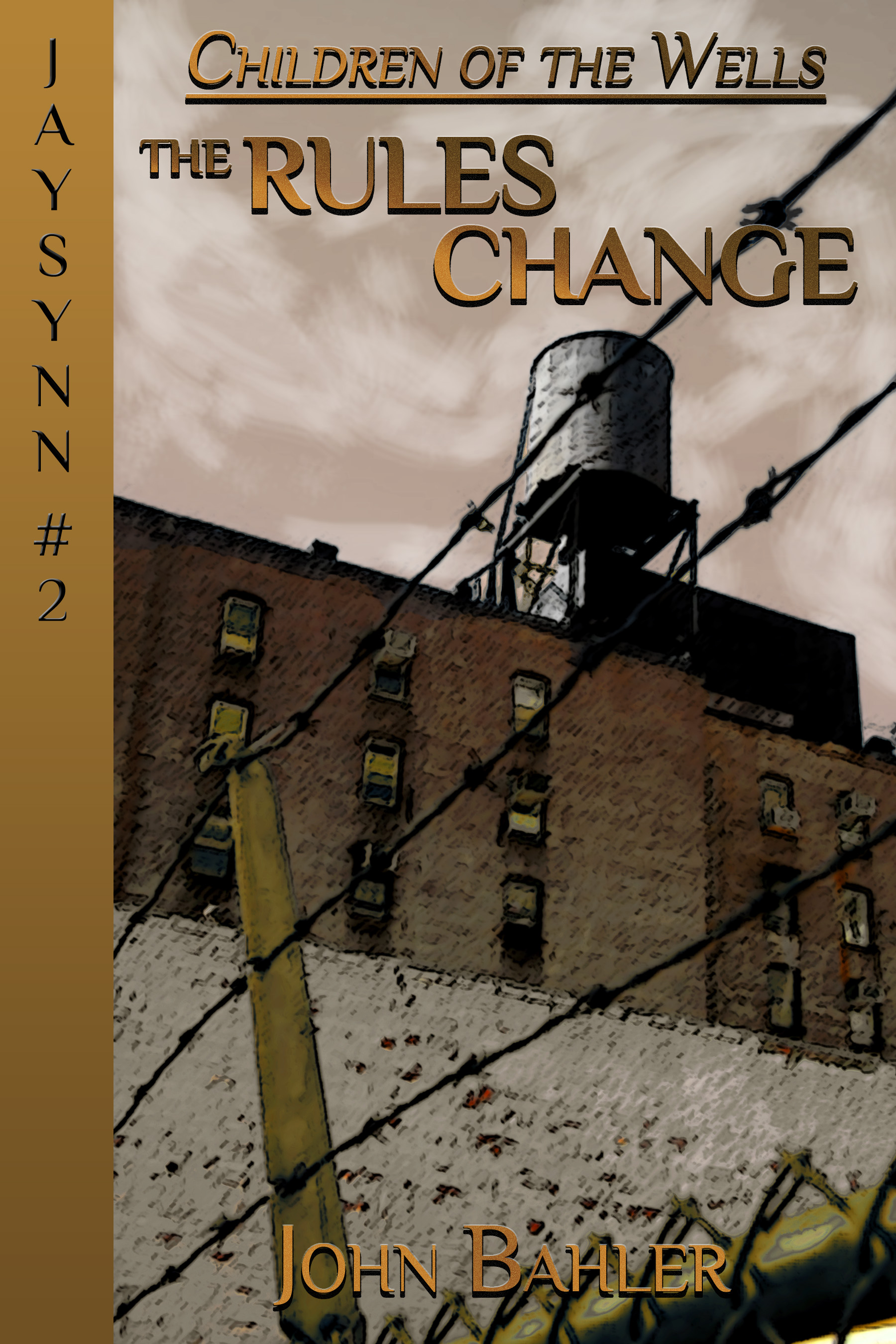
The Rules Change

Book 2 of Jaysynn

Written by John Bahler

Download ebook

After barely escaping his own city alive, Jaysynn, the last heir to the throne of Kyzer, finds himself eking out a living in a refugee camp outside an enemy city. Falcon Point, the city that rebelled against Jaysynn’s ancestors and declared its independence, now carefully guards and controls its resources in a time of devastation and chaos. Stripped of what little power he had, Jaysynn considers accepting a new life of less responsibility. But a peaceful future of anonymity alongside the peasants, including fellow refugee Kyrie, may not be possible if the leader of Falcon Point, Governor Vac, learns there is a son of Kyzer on his doorstep.

This book is available to read online. Start reading here.

Download ebook

Previous Books in this series: The Fall of the House of Kyzer

Publication Info

Word Count: ~26,000 words

Chapters: 10

Serialization start Date: October 30, 2013

Kyzer 10 – Enemy Territory

Noise and color, blending, reverberating, echoing, smearing. Paints splattering with every throbbing sound. Blood rushing to his ears. Pain shooting through his spine and neck. Wetness behind his head. Paralysis. Objects forming…perhaps…trying.

A white light blinding him. A face coalescing—a familiar face. It stops swirling.

Golden hair. Blue eyes. Lyrical voice.

Kyrie!

She is looking right at him. Fear and relief mingling in her beautiful face. She is tapping his cheek. “Look at me,” she is saying. He keeps looking at her, hypnotized.

Angry voices behind her. She is shouting at them, but her voice is vanishing in the noise. She looks away to argue.

Blacking out…

 *     *     *

An engine rumbled.

Jaysynn slowly opened his eyes, fighting for consciousness. He was lying on his back. He felt a warm blanket covering his body. He blinked to clear his vision and saw an arched gray ceiling above him. Under him, the floor shook slightly. He started to hear dozens of voices around him. The tops of upholstered seats appeared at the corners of his eyes.

A small brown-haired boy appeared above him. The boy smiled in surprised delight. “Kyrie, he’s awake!” he exclaimed, looking away.

Jaysynn heard footfalls rush toward him. Then Kyrie, her blonde hair forming a halo around her face, appeared before him. He suddenly felt safer.

“What…happened?” Jaysynn asked, moaning in pain.

Kyrie stroked his head. “Try not to move too much. You’ve been out cold for three days.”

“Where…am I?”

“You’re on a bus with me and my family. I followed you to the Hall of Records and saw you fall out of the window”—she leaned down to whisper in his ear—“Jaysynn.”

The young man’s eyes widened and he lurched to sit up, but pain and Kyrie’s hand joined forces to stop him.

“Don’t worry. I explained everything to my family.”

“You told them?” shot Jaysynn, coughing.

“I had to when I took you to our home to tend to your wounds.”

Jaysynn inhaled and exhaled in a panic.

“They like you. They always have. Both as the prince and the Watchman.”

He breathed a sigh of relief. Then he asked, “But why are we on this bus?”

“I told you we were leaving the city to seek refuge somewhere else. A smuggler with a bus that runs on steam offered to take us to his city. He says it wasn’t as devastated by the Cataclysm.”

Jaysynn tried to sit up again, but his muscles were too stiff. “Please help me up.”

Kyrie told the boy to get off the seat, which he did, and she helped Jaysynn slowly sit on that seat. The young man leaned his head against the window. A blob of light smothered his vision as his eyes adjusted to the sunlight. He heard several people—children and adults—exclaim praises in his honor.

“What happened after I fell? How was I not found by the soldiers? Why did you bring me with you? Who—”

Kyrie covered his mouth with her hand. “I’ll explain later,” she said, smiling. “For now, just rest.”

A voice from upfront—the driver—exclaimed, “We’re here!”

Jaysynn glanced out the window.

He saw a dilapidated green sign that read, “Welcome to Falcon Point.”

END OF
THE FALL OF THE HOUSE OF KYZER